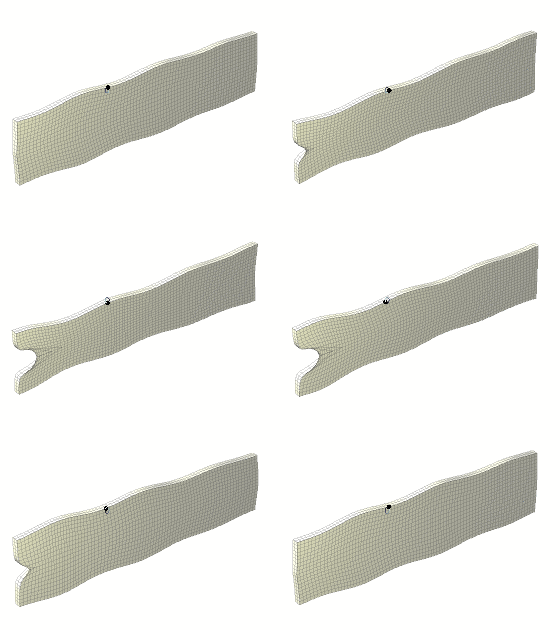
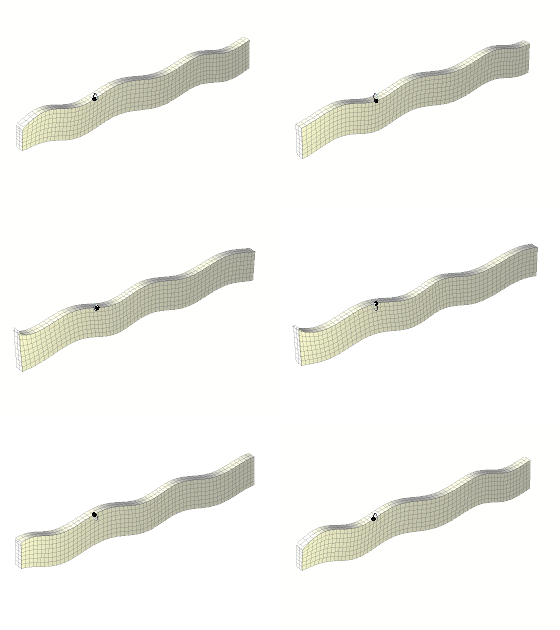
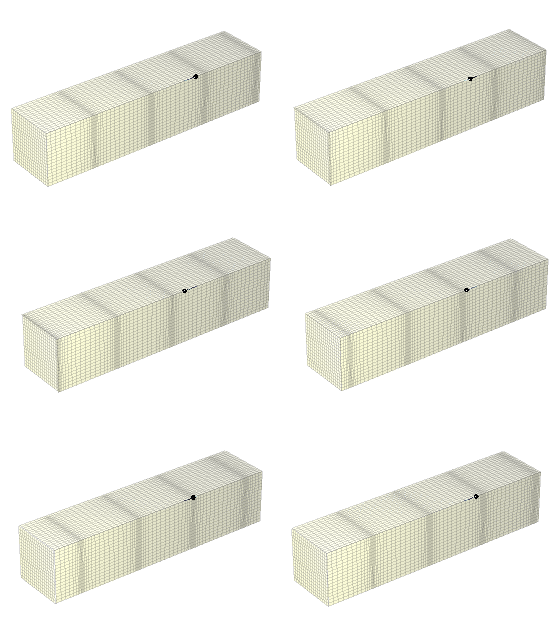
Press play to run an animation. Use the player controls to pause or view it full screen. The original GIF is available below each animation.
Mechanical waves transport disturbances through a medium. Their motion depends on the medium’s elastic properties, the direction of particle displacement and the boundaries that guide the wave. These animations compare bulk, surface and guided waves; particle displacements are exaggerated to make the motion visible.
Longitudinal waves
Particles move parallel to the direction of propagation. In a homogeneous fluid, the small-signal sound speed is
\[c_0=\sqrt{\frac{K_s}{\rho_0}}=\frac{1}{\sqrt{\rho_0\kappa_s}}.\]Here, \(K_s\) is the isentropic bulk modulus in pascals, \(\kappa_s=1/K_s\) is the isentropic compressibility and \(\rho_0\) is the equilibrium density. Bulk modulus and compressibility are reciprocal quantities.
For bulk longitudinal waves in a homogeneous, isotropic elastic solid, the shear stiffness also contributes:
\[c_L=\sqrt{\frac{K+4\mu/3}{\rho_0}},\]where \(K\) and \(\mu\) are the bulk and shear moduli. This expression describes a three-dimensional bulk wave; waves in slender rods have different effective stiffnesses.
Shear waves
Shear-wave displacement is perpendicular to propagation. SH and SV denote horizontal and vertical polarization relative to the chosen vertical propagation plane. An ideal fluid has no static shear stiffness and does not support these bulk shear waves.
\[c_S=\sqrt{\frac{\mu}{\rho_0}}.\]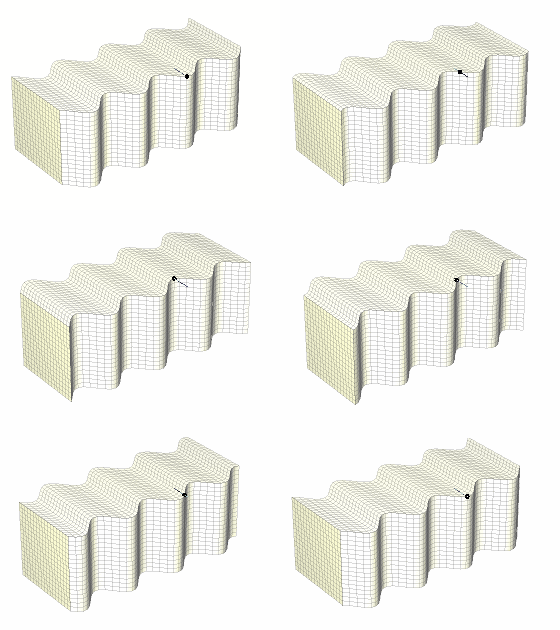
Rayleigh waves
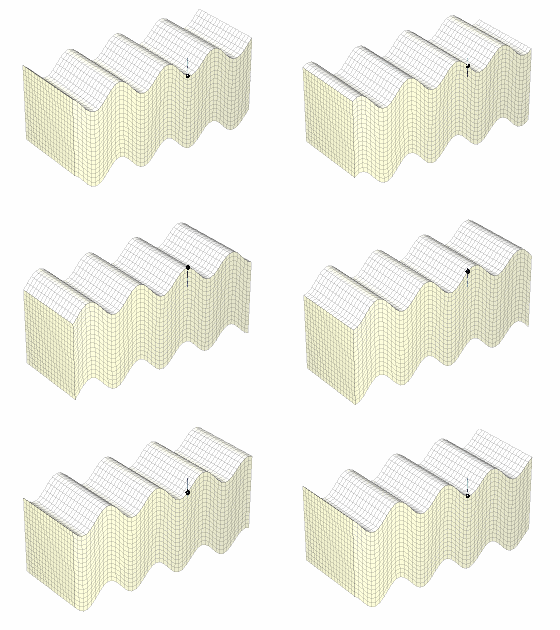
Rayleigh waves travel along a traction-free surface of an elastic solid. Coupled longitudinal and vertically polarized shear motion produces elliptical particle trajectories that decay with depth. Motion at the surface is typically retrograde relative to propagation.
The Rayleigh-wave speed depends on the elastic constants and is below the bulk shear-wave speed; it is not universally \(0.95c_S\). A fluid-loaded solid interface can support other interface waves and requires a different boundary model.
Gravity waves
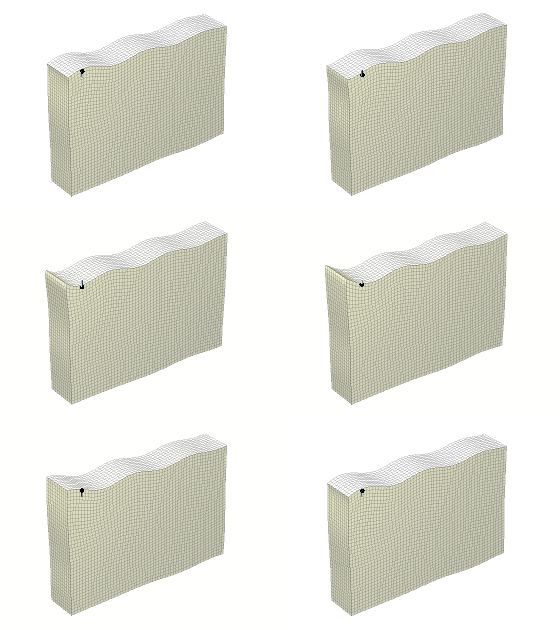
For surface gravity waves on deep water, small-amplitude particle trajectories are approximately circular and their size decreases with depth. At finite depth the trajectories become elliptical. Gravity provides the restoring force, so this motion has a different physical origin from an elastic Rayleigh wave.
Love waves
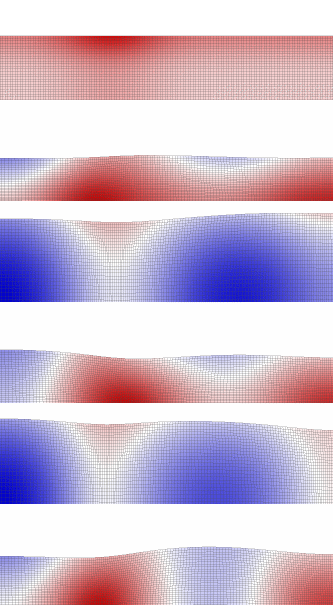
Love waves are horizontally polarized shear waves guided by a surface layer. In the simplest model, a layer with a lower shear-wave speed overlies a faster elastic substrate. The layer and free surface confine the SH motion, producing a dispersive guided wave.
Lamb waves
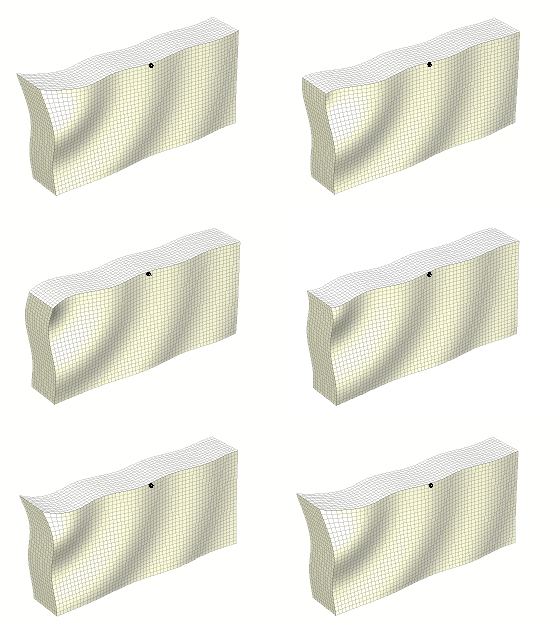
Lamb waves propagate in elastic plates and combine longitudinal and vertically polarized shear motion. The plate thickness and traction-free faces lead to symmetric \(S_n\) and antisymmetric \(A_n\) mode families. Their phase and group velocities generally depend on frequency and thickness.
At low frequency–thickness products, the fundamental \(S_0\) mode is predominantly extensional, whereas \(A_0\) is predominantly flexural. The animations illustrate these two displacement patterns.