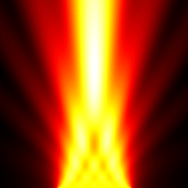
Press play to run an animation. Use the player controls to pause or view it full screen. The original GIF is available below each animation.
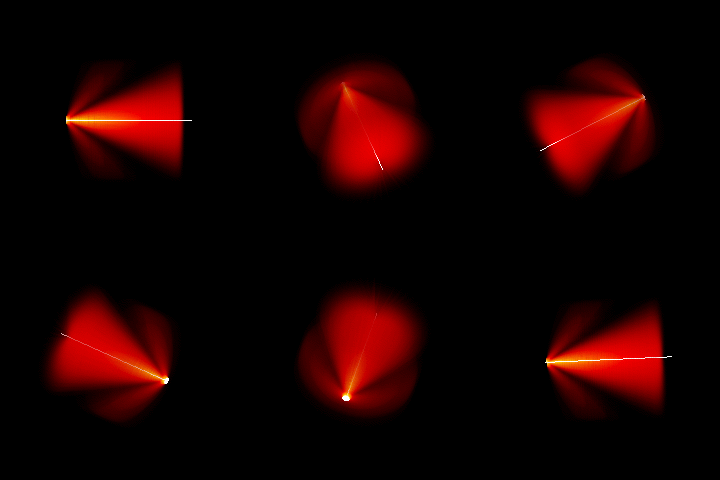
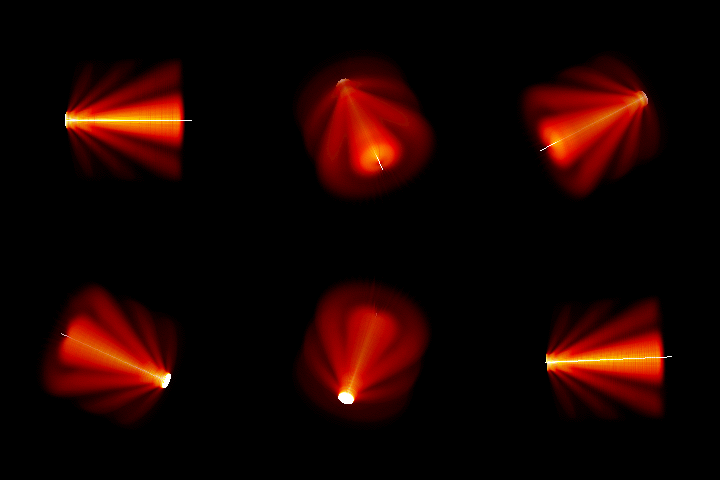
A circular piston is a useful idealization of a flat ultrasonic transducer: a disk of radius \(a\) vibrates with uniform normal velocity in an infinite rigid baffle. The examples show how diffraction changes as the dimensionless size \(ka\) increases, where \(k=\omega/c_0=2\pi/\lambda\).
For linear sound in a homogeneous fluid, use the time convention \(p=\operatorname{Re}\{\hat p e^{i\omega t}\}\). The far-field complex pressure is approximately
\[\hat p(r,\theta)\simeq\frac{i\rho_0c_0ka^2v_0}{2r}\, \frac{2J_1(ka\sin\theta)}{ka\sin\theta}\,e^{-ikr}.\]Here, \(v_0\) is the complex normal-velocity amplitude, \(r\) is distance from the piston centre, \(\theta\) is measured from its axis, and \(J_1\) is the Bessel function of the first kind and order one. The directivity factor has the limit 1 on the axis. Density and sound speed are \(\rho_0\) and \(c_0\).
This far-field expression does not describe the detailed near-field interference. For small \(ka\), radiation is nearly uniform over the radiating hemisphere; increasing \(ka\) narrows the main beam and produces side lobes.
Three-dimensional field views
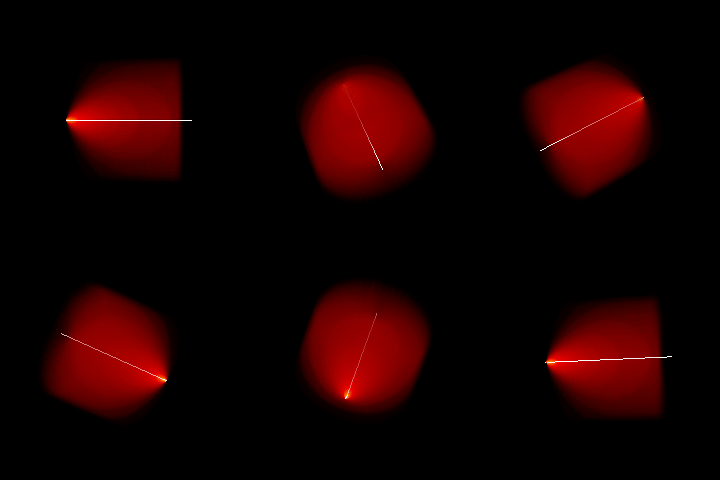
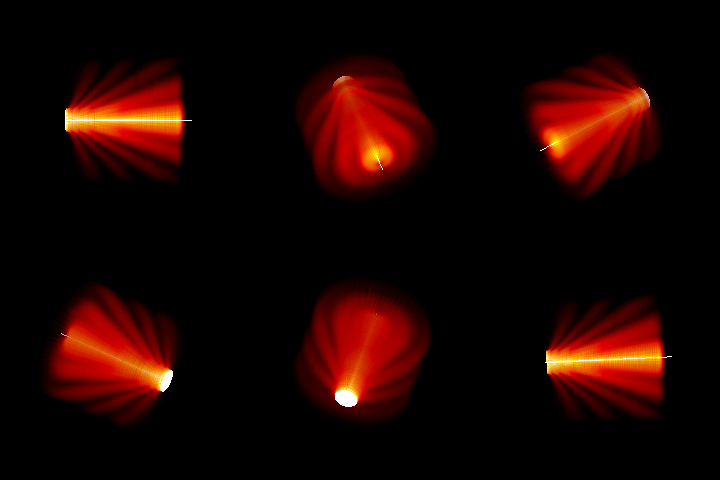
Piston at \(ka=1\)

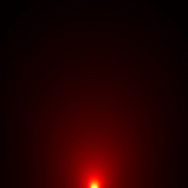

Piston at \(ka=5\)

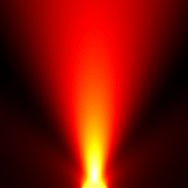

Piston at \(ka=10\)

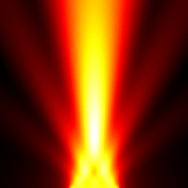

Piston at \(ka=15\)