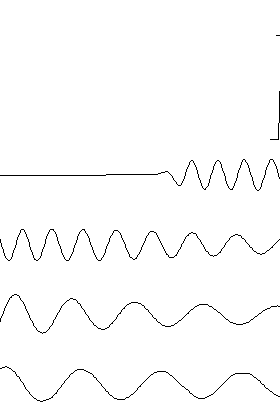
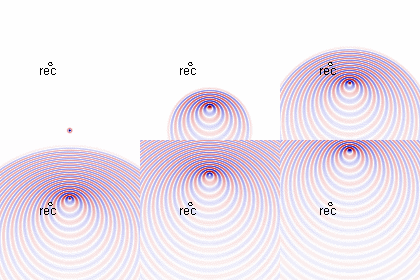
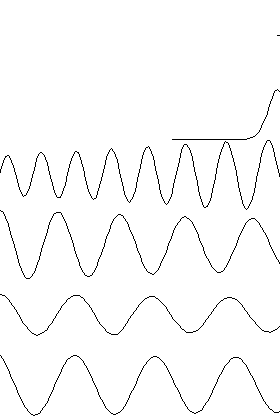
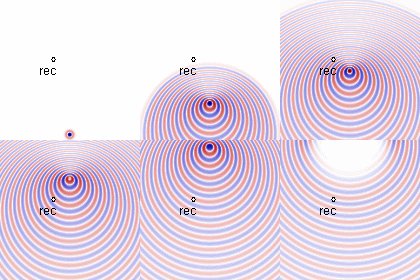
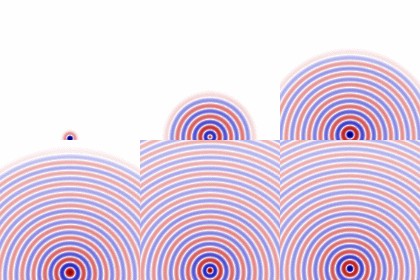
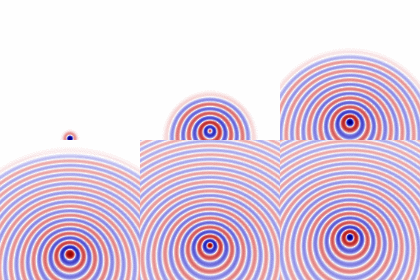
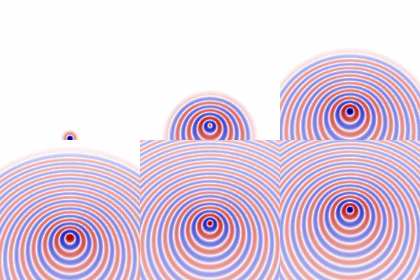
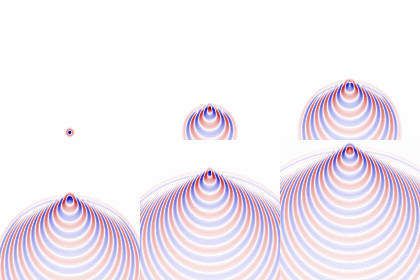
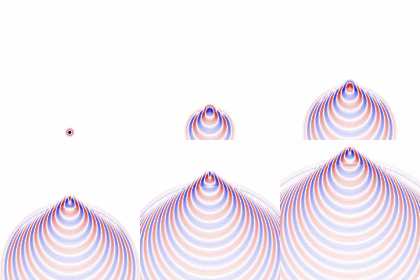
Press play to run an animation. Use the player controls to pause or view it full screen. The original GIF is available below each animation.
The Doppler effect is a change in received frequency caused by relative motion of a source and a receiver through the medium. A moving source compresses the spacing of wavefronts ahead of it and increases the spacing behind it.
For collinear motion in a stationary medium, with a subsonic source and before source and receiver pass one another,
\[f_r=f_s\frac{c_0+u_r}{c_0-u_s}.\]Here, \(u_r\) is positive when the receiver moves toward the source, and \(u_s\) is positive when the source moves toward the receiver. Both velocities are measured relative to the medium. Receding motion has the opposite sign. These definitions are essential when using the formula.
The Mach number is \(M=|v_s|/c_0\). A uniformly moving supersonic source produces a Mach cone with half-angle \(\sin\mu=1/M\). The simple approaching-source frequency formula above is not a general formula for shock arrival or for all supersonic geometries.
The archived animations below illustrate wavefront geometry. Exact Mach numbers are omitted because the original simulation inputs have not been recovered.