Press play to run an animation. Use the player controls to pause or view it full screen. The original GIF is available below each animation.
Acoustic streaming is a mean flow driven by sound. In linear acoustics, the first-order particle velocity oscillates with zero cycle average. Nonlinear momentum transfer, together with dissipation, can drive a slower flow that survives averaging over the acoustic period.
Oscillatory motion and mean flow
For a nearly periodic field with period \(T\), the local Eulerian mean velocity is
\[\overline{\mathbf v}(\mathbf x,t)=\frac{1}{T}\int_t^{t+T}\mathbf v(\mathbf x,t')\,dt'.\]This is an average at a fixed spatial position. It differs from the rapid acoustic oscillation and from the mean drift obtained by following an individual particle.
Absorption of a beam in the fluid can transfer momentum into an axial flow. Viscous boundary layers can also generate streaming. The balance of these mechanisms, together with the boundaries, determines the jet and return-flow pattern.
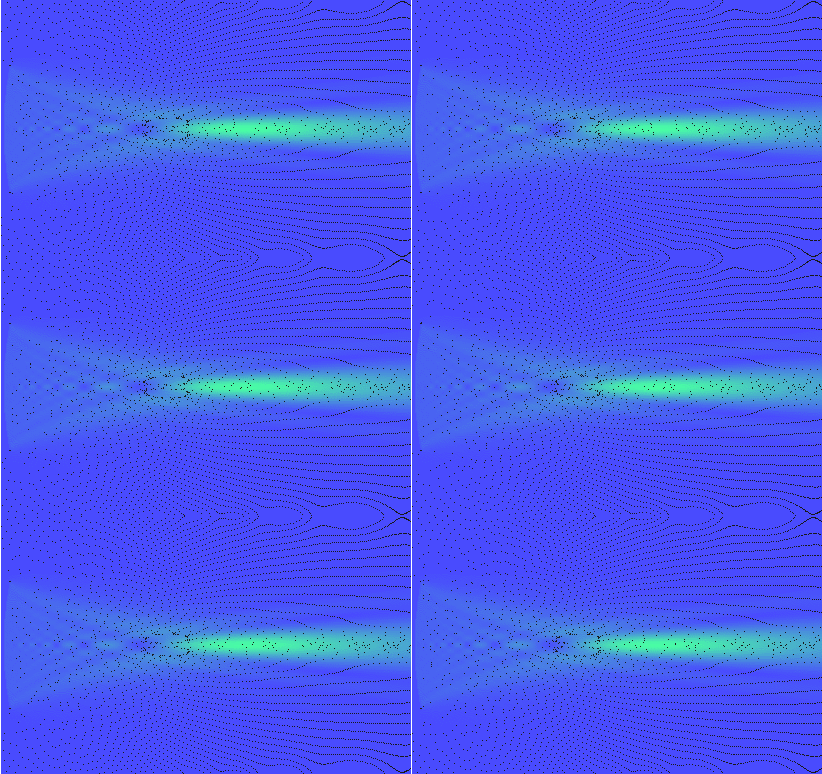
Confinement changes how fluid returns around the driven region. Compare the resonator examples for the effect of cavity geometry, wall impedance and an outlet boundary.