Press play to run an animation. Use the player controls to pause or view it full screen. The original GIF is available below each animation.
At finite amplitude, an acoustic waveform can change shape as it propagates. For a fluid with a positive coefficient of nonlinearity, compressions travel faster than rarefactions. The waveform steepens and energy transfers into higher harmonics. Dissipation competes with this steepening and gives real shock fronts a finite thickness.
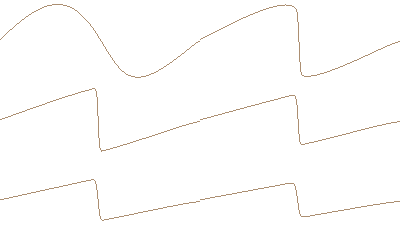
Steepening of a sinusoidal wave
For an initially sinusoidal, progressive plane wave, an inviscid, weakly nonlinear model predicts the shock-formation distance
\[z_s=\frac{c_0^2}{\beta\omega_0v_0} =\frac{\rho_0c_0^3}{\beta\omega_0p_0},\qquad \beta=1+\frac{B}{2A}.\]Here, \(p_0\) and \(v_0=p_0/(\rho_0c_0)\) are positive pressure and particle-velocity amplitudes at the source, \(\omega_0\) is angular frequency, and \(B/A\) is the equation-of-state nonlinearity parameter. This distance is a lossless reference scale, not a prediction of an infinitely sharp front in a dissipative fluid.

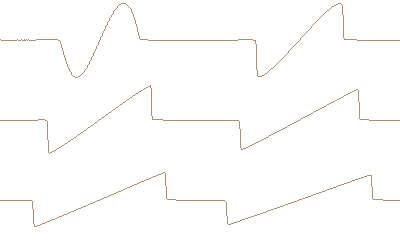
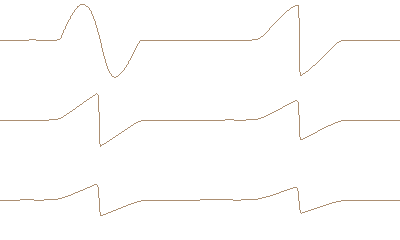
Single-cycle pulses and polarity
A pulse that starts with compression and ends with rarefaction can develop an N-shaped waveform with steep outer fronts. Reversing the polarity changes where the characteristic lines converge and can produce a steep transition near the pulse centre. Pulse duration, amplitude and dissipation all affect the evolution.


Sonic booms
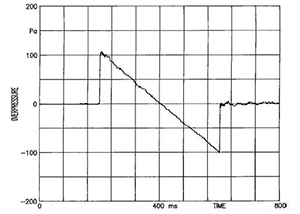
A sonic boom is associated with shock waves generated during supersonic motion. A vehicle produces them continuously while flying supersonically; an observer hears the boom when the shock system reaches their position. It is not a sound emitted only at the instant the vehicle crosses Mach 1.
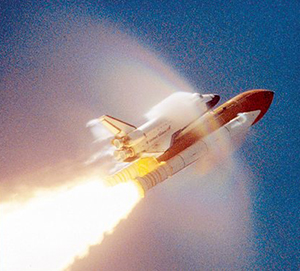
Whip cracking provides another example of rapid motion and shock formation, although its mechanics differ from plane-wave steepening in a stationary fluid.
References & further reading
- k-Wave: nonlinear plane waves and Mendousse’s solution
- k-Wave: modelling nonlinear wave propagation
- NASA: sonic booms
- Young (2002): Sonic booms of space shuttles approaching Edwards Air Force Base, 1988–1993
- Bernstein, Hall & Trent (1958): On the Dynamics of a Bull Whip
- McMillen & Goriely (2003): Whip waves