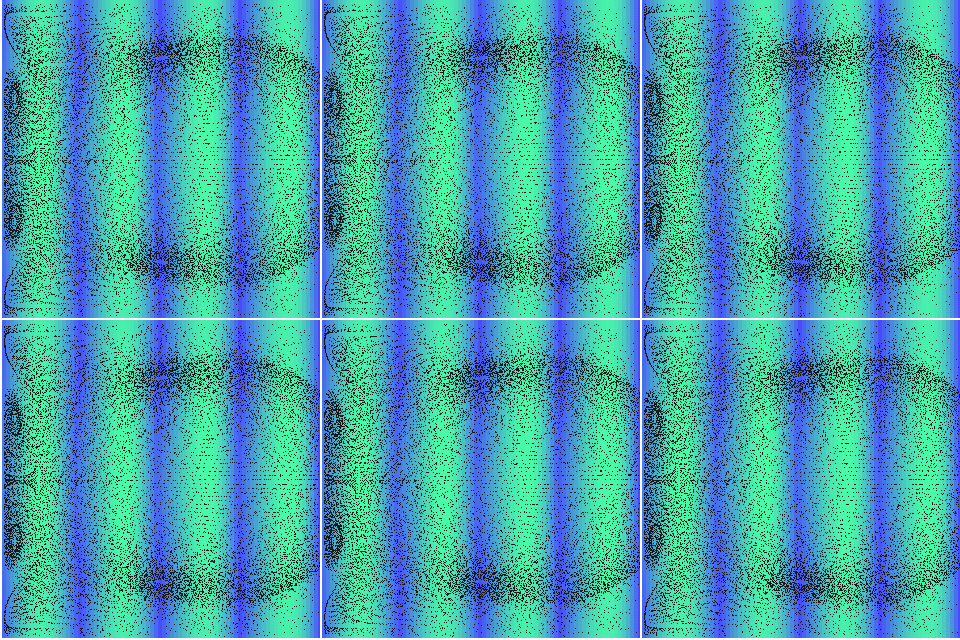
Press play to run an animation. Use the player controls to pause or view it full screen. The original GIF is available below each animation.
An acoustic cavity can sustain recirculating mean flows even when the imposed source velocity has zero cycle average. These axisymmetric, nonlinear FDTD examples show how the streaming pattern changes with geometry, drive amplitude and wall impedance. The background represents the acoustic pressure envelope.
Medium and model parameters
The archived model description specifies glycerol with \(c_0=1904\,\mathrm{m\,s^{-1}}\), \(\rho_0=1261\,\mathrm{kg\,m^{-3}}\), dynamic viscosity \(\eta=1.4\,\mathrm{Pa\,s}\), and a plane source at \(f_0=1\,\mathrm{MHz}\). These are the reported model inputs, not temperature-independent material constants.
The equation-of-state nonlinearity parameter is \(B/A\); the progressive-wave coefficient is \(\beta=1+B/(2A)\). Law, Frizzell and Dunn report \(B/A=9.4\) for glycerol under their measurement conditions, corresponding to \(\beta=5.7\). This provides a literature reference, not a recovered input for these animations: the exact coefficient used in the archived simulations has not been confirmed.
Below, \(L\) denotes axial cavity length, \(r_{\max}\) its radial extent, \(\lambda=c_0/f_0\), and \(Z_0=\rho_0c_0\). A finite wall impedance \(Z_{\mathrm{wall}}\) should not be confused with an ideal rigid wall. The numerical values in the captions retain those reported with the original examples.
Streaming in confined cavities
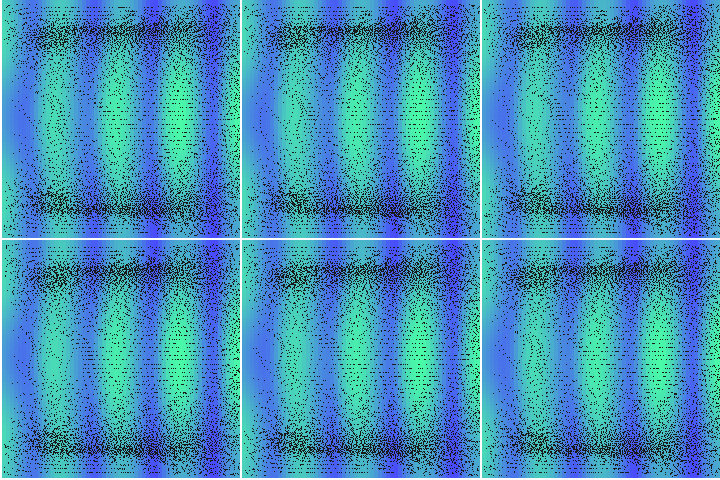
The next example changes both wall impedance and drive pressure, so the change in flow cannot be attributed to either parameter alone.
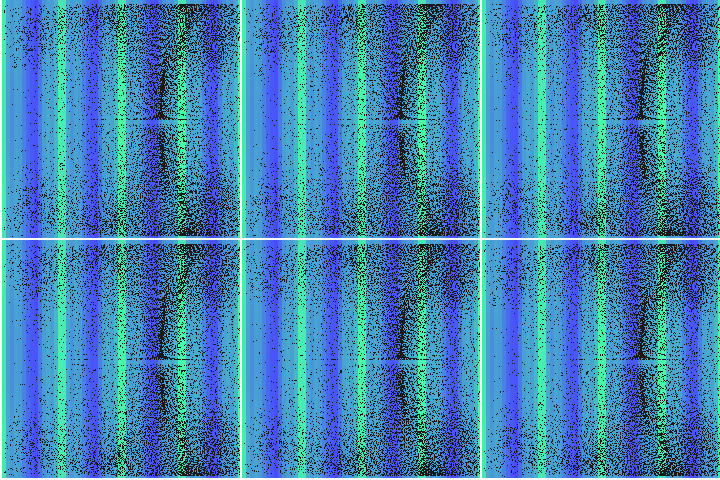
Increasing the cavity length changes the acoustic field and the available recirculation paths.
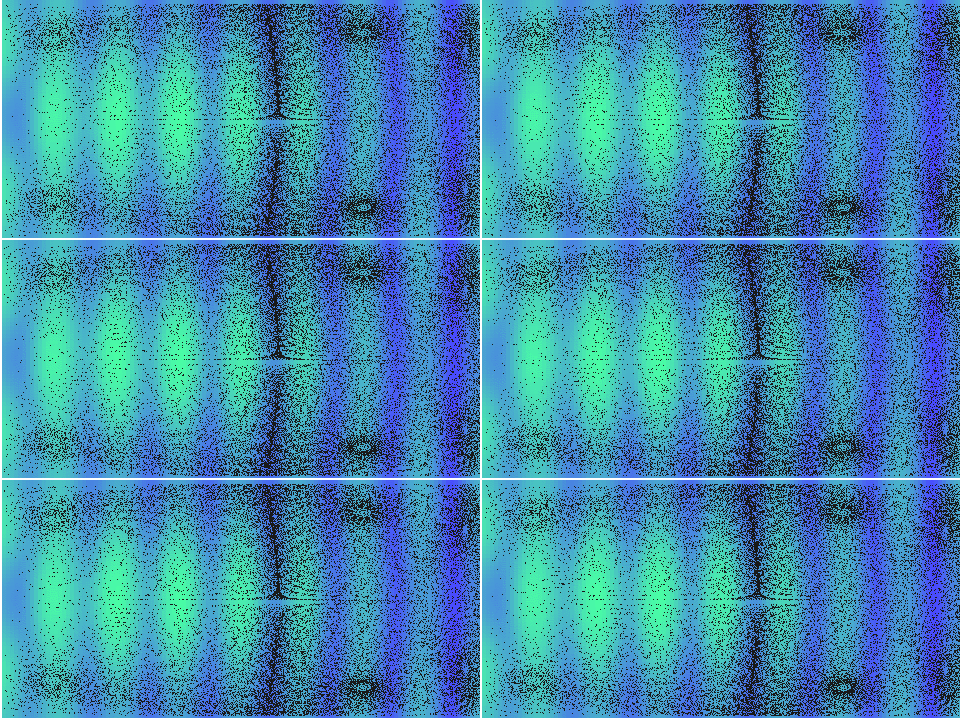
An idealized outlet boundary
The final example uses a zero axial velocity-gradient condition at the end of the domain, reported as
\[\left.\frac{\partial v_z}{\partial z}\right|_{z=z_{\max}}=0.\]This is an idealized numerical outlet condition. It can permit flow across the computational boundary; it is not by itself an exact acoustic radiation condition or a physical free-surface condition. Fluid crossing the boundary comes from or enters the exterior, rather than being created as a mass source. A complete physical system must satisfy mass conservation, including its external return flow.