Research focus
Acoustic holographic lenses shape the phase of an ultrasonic wavefront to produce a desired field. My research explores 3D-printed lenses that compensate for skull aberrations and focus ultrasound on complex targets, alongside methods for measuring and monitoring the resulting fields.
Focused ultrasound has demonstrated spectacular capabilities for the treatments of neurological disorders as well to open new paths to deliver drugs in the central nervous system. However, focusing through the skull supposes a challenge due to the high acoustic impedance contrast, refraction index and absorption that present the skull bones. I'm interested in developing new tools to focalize and control acoustic beams into de central nervous system. These research lines include:
Lines:
Holograms for transcranial focusing
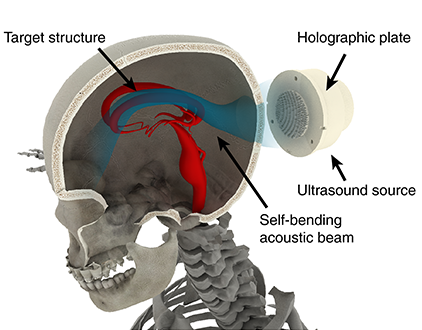
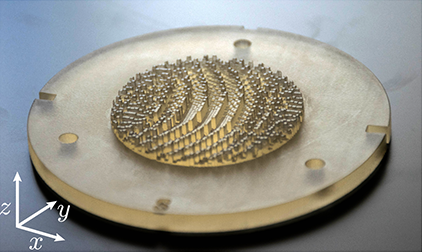
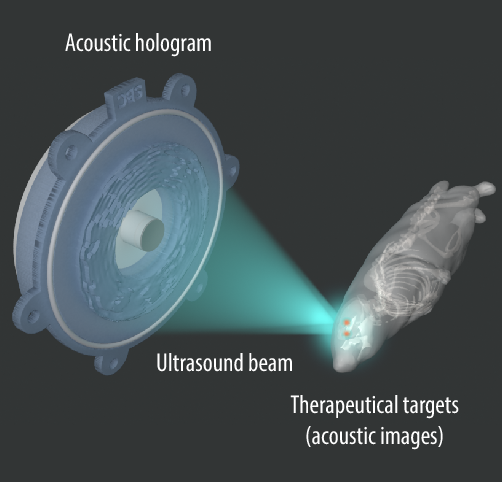
In this research line we develop passive focusing methods based on acoustic holograms to produce focused beams inside the central nervous system. In particular, we are able to produce beams whose spatial distribution fits a target structure of arbitrary shape, such as deep-brain nuclei. In this way, using 3D-printed holographic lenses we are developing low-cost focusing systems that will help to disseminate incoming therapeutic ultrasound techniques as neuromodulation or blood-brain barrier opening to treat neurological disorders.
Currently we have validated this technique in vivo, opening the blood-brain barrier in small animals in symetrical regions in separate hemispheres. In addition, holograms are able to encode the multiple reflections inside the cranial walls, increasing the angular spectrum of the focused beams. This result in sharper focal spots, that can be as narrow as the diffraction limit.
Related publications
- 2024 · Journal article
Monitoring holograms for therapeutic ultrasound using passive cavitation beamforming
Applied Acoustics, 224, 110144, 2024
- 2023 · Journal article
Methods to design and evaluate transcranial ultrasonic lenses using acoustic holography
Physical Review Applied, 20 (4), 044071, 2023
- 2022 · Journal article
Numerical study of acoustic holograms for deep-brain targeting through the temporal-bone window
Ultrasound in Medicine and Biology, 48 (5), 872--886, 2022
- 2022 · Journal article
Acoustic holograms for bilateral blood-brain barrier opening in a mouse model
IEEE Transactions on Biomedical Engineering, 69 (4), 1359 -- 1368, 2022
- 2021 · Journal article
Hologramas acústicos multifocales para la focalización de ultrasonidos en estructuras cerebrales profundas
Revista de Acústica, 52 (1-2), 17-25, 2021
- 2019 · Journal article
On the Evaluation of the Suitability of the Materials Used to 3D Print Holographic Acoustic Lenses to Correct Transcranial Focused Ultrasound Aberrations
Polymers, 11 (9), 1521, 2019
- 2019 · Journal article
Holograms to focus arbitrary ultrasonic fields through the skull
Physical Review Applied, 12 (1), 014016, 2019
Related conference contributions (9)
- 2025 · Conference contribution
Hologram-assisted focused ultrasound for brain therapy
ASA/ICA 2025: 188th Meeting of the Acoustical Society of America joint with 25th International Congress on Acoustics. New Orleans, Louisiana, USA, 18 - 23 May 2025, Invited, 2025
- 2025 · Conference contribution
Acoustic holograms for both therapy and monitoring transcranial ultrasound
ASA/ICA 2025: 188th Meeting of the Acoustical Society of America joint with 25th International Congress on Acoustics. New Orleans, Louisiana, USA, 18 - 23 May 2025, Invited, 2025
- 2022 · Conference contribution
Acoustic holograms for low-intensity ultrasound neuromodulation in non-human primates
FUN 2022: Focused Ultrasound Neuromodulation. Mainz, Germany. 26-28 September, Poster, 2022
- 2022 · Conference contribution
Acoustic Holograms for Bilateral Blood-brain Barrier Opening in Mice
ISTU 2022: 21th International Symposium for Therapeutic Ultrasound. Toronto, Canada. 7 - 10 June, Oral, 2022
- 2021 · Conference contribution
Ultrasound holograms to enhance deep-brain neuromodulation
FUN 2021: Focused Ultrasound Neuromodulation. Online. 7-10 September, Poster, 2021
- 2021 · Conference contribution
Therapeutic ultrasound holograms to target thalamic nuclei through the temporal bone window.
EuroNoise 2021: European Congress and Exposition on Noise Control Engineering. Madeira, Portugal. 24-27 October, Oral, 2021
- 2021 · Conference contribution
Hologramas ultrasónicos para tratamientos neurológicos
X Reunión del Capítulo Nacional Español de la Sociedad Europea de Biomecánica. Granada, Spain. 26 October, Oral, 2021
- 2021 · Conference contribution
Transtemporal Ultrasound Holograms for Thalamic Therapy
IUS 2021: IEEE International Ultrasonics Symposium. Xi'an, China. 11-16 September, Oral, 2021
- 2021 · Conference contribution
Acoustic holograms for thalamic focusing through the temporal-bone window
180th Meeting of the Acoustical Society of America, Acoustics in Focus. Online, 8 - 10 June, Oral, 2021
Vortices in the brain
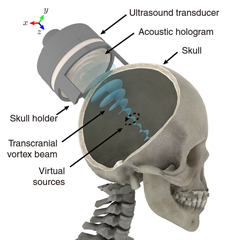
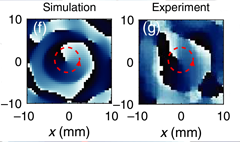
Acoustic vortex beams have great potential for contactless particle manipulation and torque-based biomedical applications. However, when focusing acoustic waves through aberration layers such as the human skull at ultrasonic frequencies results in strong phase aberrations which prevent the generation of sharp acoustic images. In the case of a wavefront containing phase dislocations, skull aberrations inhibit the focusing of acoustic vortex beams inside the cranial cavity.
We demonstrate that phase-conjugated acoustic holograms can encode time-reversed fields simultaneously allowing the compensation of the aberrations of the skull and the generation of a focused vortex inside an ex-vivo human skull. The method is applied for single-element geometrically focused sources and results in a very simple and compact ultrasonic system. The technique was tested using an exvivo skull inside a water tank. Measurements show that a vortex was correctly synthesized using an acoustic hologram. This technique can be used to design low-cost particle trapping applications, clot manipulation, torque exertion in the brain and acoustic-radiation-force based biomedical applications.
Related publications
- 2020 · Journal article
Transcranial focusing of ultrasonic vortices by acoustic holograms
Physical Review Applied, 14 (5), 054070, 2020
Holographic thermal patterns for hyperthermia
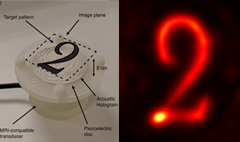
Holograms can shape wavefronts to produce arbitrary acoustic images. Compared to light, acoustic waves can penetrate much deeper into biological media. Therefore, acoustic holograms are bursting onto current biomedical applications due to their capability to shape and focus ultrasound fields inside living tissues. Acoustic waves transport energy, and when propagating into biological media, a fraction is irreversibly transformed into heat by viscoelastic and relaxation processes. In ultrasound imaging applications, the temperature rise is negligible because the total energy of the wave is moderate.27 However, at high ultrasound intensities, heat deposition can be elevated and fast enough to create cell necrosis and tissue ablation. Combined with sharp focusing, high intensity focused ultrasound is currently used in clinics for therapeutical purposes.
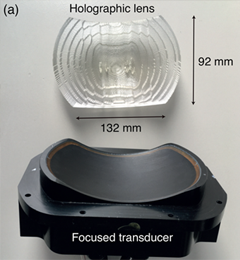
Recently, attention has been paid to intermediate regimes, when ultrasound is used to create a local and mild hyperthermia, which is defined as an increase in the tissue temperature between 39 and 45C, typically with long exposure times.30–32 HIFU-mediated hyperthermia is emerging as a highly promising therapeutic approach that has been shown to activate the immune system and/or enhance drug delivery, in particular, for chemotherapeutic drug administration.
We have experimentally demonstrated how acoustic holograms can produce controlled thermal patterns in absorbing media at ultrasonic frequencies. Magnetic resonance imaging (MRI)-compatible holographic ultrasound lenses were designed by time-reversal methods and manufactured using 3D-printing. Several thermal holographic patterns were measured using MRI thermometry and a thermographic camera in gelatin-milk phantoms and in an ex vivo liver tissue. The results show that acoustic holograms enable spatially controlled heating in arbitrary regions. Increasing the temperature using low-cost and MRI-compatible holographic transducers might be of great interest for many biomedical applications, such as ultrasound hyperthermia, where the control of specific thermal patterns is needed.
Related publications
- 2023 · Journal article
Holographic Focused Ultrasound Hyperthermia System for Uniform Simultaneous Thermal Exposure of Multiple Tumor Spheroids
Cancers, 15 (9), 2540, 2023
- 2022 · Journal article
Thermal holographic patterns for ultrasound hyperthermia
Applied Physics Letters, 120 (8), 084102, 2022
Related conference contributions (5)
- 2026 · Conference contribution
Uniform thermal dose delivery to multiple tumour spheroids using a holographic focused ultrasound system
ECMP 2025: 6th European Congress of Medical Physics. València, Spain. 23-26 September, Oral, 2026
- 2022 · Conference contribution
An Exposure System for In-vitro 3D Tumour HIFU Studies
ISTU 2022: 21th International Symposium for Therapeutic Ultrasound. Toronto, Canada. 7 - 10 June, Poster, 2022
- 2021 · Conference contribution
Ultrasonic holograms to enhance hyperthermia volumes
EuroNoise 2021: European Congress and Exposition on Noise Control Engineering. Madeira, Portugal. 24-27 October, Oral, 2021
- 2021 · Conference contribution
Ultrasonic Holograms to Enhance Hyperthermia Volumes
IUS 2021: IEEE International Ultrasonics Symposium. Xi'an, China. 11-16 September, Oral, 2021
- 2021 · Conference contribution
Acoustic holograms for large-volume hyperthermia
ISTU 2021: 20th International Symposium for Therapeutic Ultrasound. Gyeongju, Korea. 6 - 9 June, Oral, 2021
Transcranial ultrasound for blood-brain barrier opening
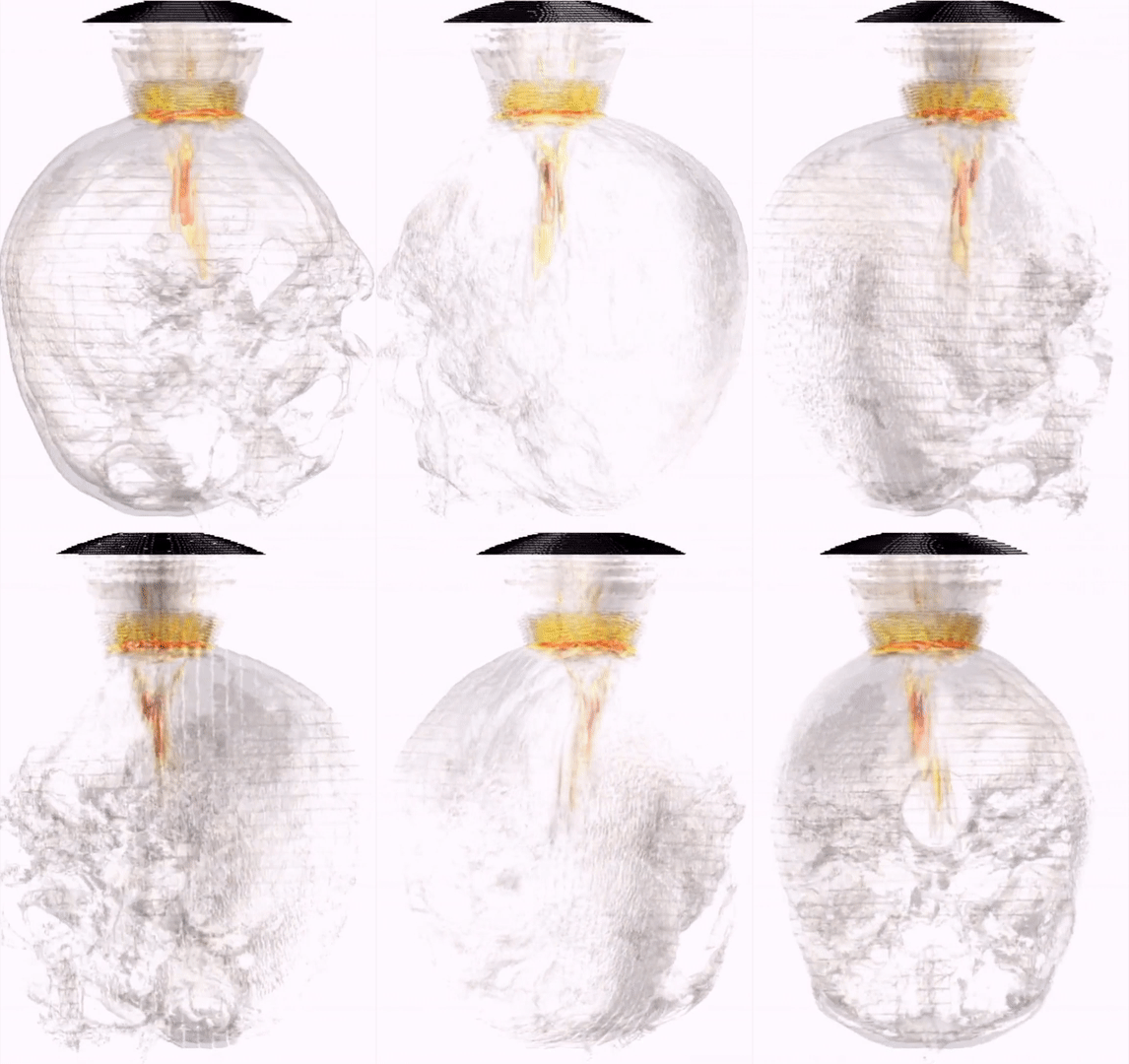
The blood-brain barrier (BBB) restricts the diffusion of microscopic objects, e.g., protecting the brain from infections. However, it also prevents the passage of most therapeutic drugs. BBB disruption can be achieved by using transcranial focused ultrasound and microbubble injection in an effective, non-invasive, transient, localized and safe manner. Thus, the BBB opening enables drug delivering to specific areas of the brain, which is mandatory in research of treatments for neurological disorders as Alzheimer’s or Parkinson’s diseases. At the UMIL we develop simulations and experiments to define a protocol for the transcranial targeting of the hippocampus of an adult human by using a single-element focused transducer. In this line I'm working at the Ultrasound Medical and Industrial Laboratory (UMIL) Universitat Politècnica de València (Spain) and Columbia University (USA) to study the acoustic aberrations produced in transcranial propagation and methods to correct them. We develop simulations and experiments to define a protocol for the transcranial targeting at human hippocampus by using a single-element focused transducers.
In the right animation you can see an example of the transcranial beam propagation generated by a mono-element 500 kHz transducer, obtained by numerical simulation by PhD student Sergio Jiménez-Gambín who is working in this topic (now postdoc at Columbia University). The simulations, based on the k-space method, allow to evaluate the beam aberrations and predict precisely the central nervous system area to be treated.
Related publications
- 2019 · Journal article
On the Evaluation of the Suitability of the Materials Used to 3D Print Holographic Acoustic Lenses to Correct Transcranial Focused Ultrasound Aberrations
Polymers, 11 (9), 1521, 2019
- 2019 · Journal article
Holograms to focus arbitrary ultrasonic fields through the skull
Physical Review Applied, 12 (1), 014016, 2019
- 2019 · Journal article
Efecto del método de definición de las propiedades acústicas de cráneo humano en la propagación focalizada de ultrasonidos
Revista de Acústica, 50 (1-2), 22-25, 2019
- 2014 · Conference contribution
Transcranial Propagation with an Ultrasonic Mono-Element Focused Transducer
UIA 2014: 43rd Annual UIA Symposium. Madrid, Spain. 23 - 25 April, Oral, 2014
- 2012 · Journal article
Estudio de la propagación no lineal de haces de ultrasonidos focalizados a través del cráneo para la apertura de la barrera hematoencefálica
Revista de Acustica, 43 (1), 5-11, 2012
Related conference contributions (6)
- 2022 · Conference contribution
Acoustic Holograms for Bilateral Blood-brain Barrier Opening in Mice
ISTU 2022: 21th International Symposium for Therapeutic Ultrasound. Toronto, Canada. 7 - 10 June, Oral, 2022
- 2013 · Conference contribution
Estudio paramétrico de la propagación transcranial de un haz ultrasónico para la apertura de la barrera hematoencefálica
Tecniacústica 2013: 44º Congreso Español de Acústica y Encuentro Ibérico de Acústica. Valladolid, Spain. 2 - 4 October, Oral, 2013
- 2013 · Conference contribution
Parametric study of transcranial focused ultrasound propagation for blood–brain barrier opening
RSEF 2013: XXXIV Reunión Bienal de la Real Sociedad Española de Física. Valencia, Spain. 15 - 19 July, Poster, 2013
- 2013 · Conference contribution
Parametric study of transcranial focused ultrasound propagation for blood–brain barrier opening
ESUCB 2013: 5th European Symposium on Ultrasonic Characterization of Bone. Granada, Spain. 7-10 May, Oral, 2013
- 2011 · Conference contribution
Estudio de la propagación no lineal de haces de ultrasonidos focalizados a través del cráneo para la apertura de la barrera hematoencefálica
Tecniacústica 2011: 42º Congreso Español de Acústica y Encuentro Ibérico de Acústica. Cáceres, Spain. 26 - 28 October, Oral, 2011
- 2011 · Conference contribution
Numerical study of nonlinear, transcranial focused ultrasound wave propagation for blood-brain barrier (BBB) opening
ISTU 2011: 11th International Society for Therapeutic Ultrasound Symposium. New York, USA. 11-13 April, Oral, 2011
More publications in this research area
- 2025 · Journal article
Acoustic holography in biomedical applications
Physics in Medicine and Biology, 70 (6), 06TR01, 2025
- 2023 · Book chapter
Materials for Acoustic Wave Generation and Modulation
In: Acoustic Technologies in Biology and Medicine, Wiley-VCH Verlag GmbH, pp. 317-331, 2023
- 2018 · Journal article
Transport and Preservation of Liver in a Revolutionary Medical Device
Transplantation, 102, S789, 2018
Related conference contributions (7)
- 2025 · Conference contribution
Revolucionando la litotricia: Tratamiento en litiasis urinarias mediante emisión de vórtices acústicos
LXXXVIII Congreso Nacional de Urología. Cádiz, Spain, 11 - 13 Juny 2025, Poster, 2025
- 2025 · Conference contribution
Lithovortex project: Creating new ways for urinary lithotripsy
EAU25: 40th Annual Congress of the European Association of Urology, Madrid, Spain. 21-24 March 2025, Poster, 2025
- 2025 · Conference contribution
Lithotripsy of urinary stones by vortex waves: improving a useful treatment
AUA 2025: 2025 Annual Meeting of the American Urological Association (AUA), Las Vegas, USA. 26-29 April, Poster, 2025
- 2025 · Conference contribution
Litotricia en litiasis urinarias mediante emisión de vórtices: potenciando un tratamiento eficaz
XXXIV Reunión Nacional de los Grupos de Litiasis y de Endourología, Laparoscopia y Robótica. Bilbao, Spain, 30 - 31 January 2025, Poster, 2025
- 2022 · Conference contribution
Reflectors for Therapeutic Vortex Beam Generation
ISTU 2022: 21th International Symposium for Therapeutic Ultrasound. Toronto, Canada. 7 - 10 June, Poster, 2022
- 2022 · Conference contribution
A Low-intensity Ultrasound Delivery System using Acoustic Holograms
ISTU 2022: 21th International Symposium for Therapeutic Ultrasound. Toronto, Canada. 7 - 10 June, Oral, 2022
- 2021 · Conference contribution
Holographic lenses to enhance thalamic therapy through the temporal bone window
ISTU 2021: 20th International Symposium for Therapeutic Ultrasound. Gyeongju, Korea. 6 - 9 June, Oral, 2021